Why the Data You’re Not Capturing Is Slowly Killing Your Winery
There is a question every winery owner should sit with for a moment. Dan Murphy’s, a bottle shop, not a fine wine destination, not a 40-acre estate in the Barossa with a view and a wood-fired kitchen, has a KPI built into every single staff interaction to enrol customers into their loyalty program. As of 2025, My Dan’s has 5.5 million active members. Those members drive 90% of the company’s total sales. Scan rates for the program have grown from 23% in 2015 to 83% in 2025. Personalised messaging to members results in spend 1.2 times the average.
A liquor retailer. Running a tighter customer data operation than most Australian wineries.
If your response to that is ‘but we’re a small winery, we’re different,’ with respect, you are not. You have something Dan Murphy’s can never have: a visitor standing in front of you, wine glass in hand, in the place where the wine was made, more open to connection than they will ever be at a checkout counter in a shopping centre car park. You have the greatest marketing moment in the entire supply chain. And most wineries are letting it walk out the door unnamed, unrecorded, and unreachable.
The Data Leak Nobody Talks About
The Australian wine industry’s direct-to-consumer (DTC) channel is under structural pressure. Unique customer numbers across the DTC channel fell 5.8% in the most recent reporting period according to Wine Australia’s 2024 Direct to Consumer Report, based on 1.3 million actual
transactions. The cellar door remains the single largest DTC revenue driver, accounting for 46% of total net DTC sales, but the pool of new people engaging is shrinking. That means every visitor is worth more than they were five years ago. And the majority of them are leaving without a trace.
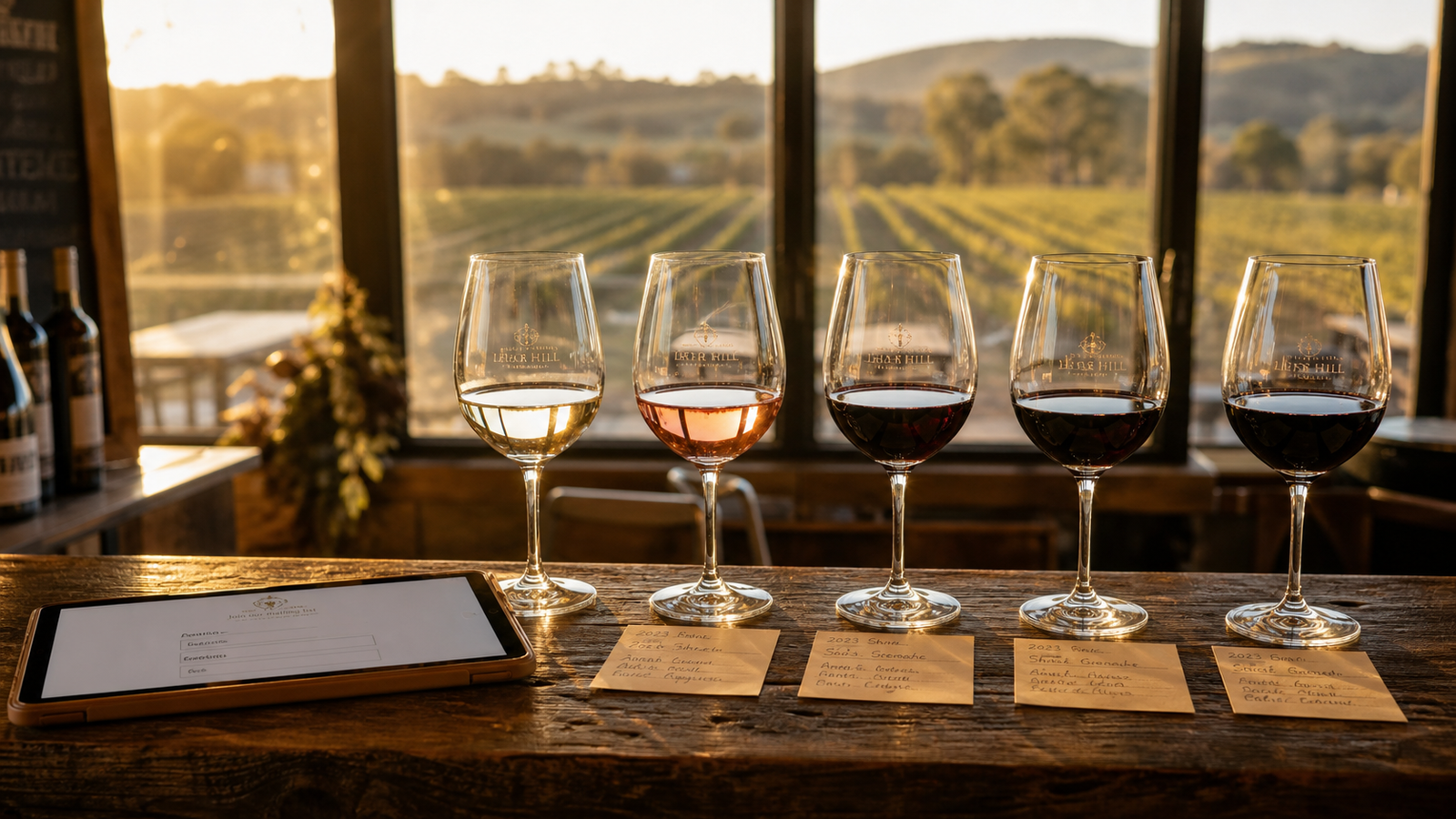
Think about what happens at a typical cellar door tasting. Someone drives past your sign, or they booked online, or a friend told them the Shiraz was worth the trip. They spend 45 minutes with your team. They taste five wines. They learn something. They feel something. They might even buy a bottle. And then they leave, taking all of that, their preferences, their price ceiling, their curiosity about varieties they hadn’t tried before, with them. This is not a traffic problem. It is a capture problem.
Why Demographics Are Not the Answer
Before we talk about what data to collect, let’s clear up a common mistake: the assumption that knowing someone’s age and gender gives you meaningful marketing power. It doesn’t. Not reliably. Yes, there are broad patterns, research on wine consumer behaviour shows gender and generational cohort produce some observable differences in varietal preference and purchasing channel. But the academic literature is clear on the limitation: gender and age are not strong predictors of personal wine consumption in isolation. A 2025 study from Charles Sturt University using Bayesian network analysis across seven Australian wine regions found that individual mood, personality, and whether visitor expectations were exceeded had more measurable influence on purchase and loyalty behaviour than demographic category.
Here is the practical problem: if you segment your email list by ‘female, 35-45’ and ‘male, 50+’, you are making a probability bet across a field of variables so wide that you will be wrong more often than you are right. You will send a Rose campaign to someone who bought your GSM twice. You will pitch a reserve Cabernet to someone who spent forty minutes asking about your sparkling.
The customers who actually convert, who join clubs, who reorder online, who recommend you to their friends, do not do so because of their demographic profile. They do so because of their behaviour. What did they buy? At what price point? What did they ask about twice? Do they want to hear from you again? Those four questions predict revenue. Date of birth does not. Behavioural segmentation outperforms demographic segmentation in purchase prediction across virtually every consumer category. The cellar door is where you capture behavioural signals in real time, for free, from a warm and willing audience.
The Five Data Points That Actually Matter
You do not need a complex form. You need a consistent one. These are the five fields that translate into segmented, revenue-driving follow-up:
- Email address. Your only owned, direct line to that visitor once they leave your postcode. Commerce7 data from across 1,700 winery clients shows the top 10% of wineries, those capturing email at 88% of transactions, sell double what the bottom 10% sell online, per dollar of tasting room revenue.
- Style preference. Not a Myers-Briggs, not a psychographic survey. Just: did they go back to the white? Did they ask about the Riesling twice? This one data point lets you send relevant follow-up rather than blasting your whole list with a Shiraz release to people who love your sparkling.
- Price comfort. The price point they purchased at is the clearest behavioural signal you have. A visitor who buys a $38 Pinot has different expectations and a different ceiling than someone who picks up a $75 reserve. Treat them differently in every follow-up touchpoint.
- Region or variety interest. Ask one question: is there a region or variety you want to explore more? The answer tells you exactly what to put in the subject line of their next email. Younger consumers are more willing to experiment across styles, and the cellar door is where that curiosity is most convertible.
- Revisit intent. A single opt-in question: would you like to hear about upcoming events or releases? This converts a visitor into a subscriber without feeling clinical. Wine club members buy nearly 2.5 times more wine than non-members, and 75% of wineries source club members directly from the tasting room.
The RFM Frame You Cannot Ignore
There is a reason high-performing DTC businesses use RFM segmentation as their baseline: Recency, Frequency, Monetary value. Who bought recently? Who has bought more than once? How much do they spend per transaction? RFM-based targeting produces higher open rates, higher conversion rates, and higher average order values because it matches the offer to the actual behaviour of the customer. The Wine Australia DTC Report is explicit: wineries using personalised communications and RFM-informed segmented offers extract more growth and lifetime value from their existing customer base.
But here is the part that should make every cellar door manager uncomfortable: you cannot run RFM on people you have no record of. Traffic without capture is not a revenue foundation, it is a revolving door. And in a category where domestic wine consumption has been trending into
negative volume growth for five consecutive years, and DTC shipment volumes dropped globally, you cannot afford to keep running a revolving door.
Three Ways to Capture Data Without Asking for It
The best capture systems are invisible. They feel like convenience. The data appears in your CRM without the customer feeling like they did anything administrative at all. Here are three methods that actually work in 2026; none of which require a new staff script.
- WiFi Login as the Natural Gateway
When a visitor arrives at your property particularly in a regional area of NSW, Victoria, or South Australia where mobile data coverage can be patchy their phone is instinctively looking for WiFi. That behaviour already exists. The question is whether you have built anything to meet it. A WiFi captive portal requires a user to complete a brief sign-in form before gaining access to your network. The capture rates are not marginal: paper sign-up rates sit at 2-5%, while WiFi captive portals convert at 40-60%. The average captive portal opt-in rate across all authentication methods and venue types is 63%. In a regional cellar door setting, this is not a hard sell, people genuinely
want the WiFi. You are not asking them for something; you are giving them something, and the entry requirement is a name and an email address. Platforms like Purple and MyWiFi Networks offer hosted captive portal solutions that integrate directly with standard CRM and email marketing tools. - The Tasting Mat with a QR Code on the Back
Physical tasting mats sit in front of your guest for the entire tasting experience, 45 minutes of dwell time on a single piece of printed material. Most of them are one-sided. Most of them waste the back. A QR code on the reverse linked to a 3-question form on your websitem, is one of the most frictionless data capture mechanisms available. The visitor scans it at the end of the tasting, when
they are at peak engagement. The form asks: which wine was your favourite today, what style would you like to explore more, and would you like to hear about our next small-batch release? Three questions. Thirty seconds. Data goes directly into your system tagged to that visit. The QR code on wine labels has been used by Australian wineries since at least 2011 so the technology is not new. What is new is using it at the moment of maximum brand affinity. - The Email Receipt as the Default
Every purchase at your cellar door produces a receipt. Make email the default, not the opt-in. This is how every high-performing retail operation in Australia now works, from Woolworths to independent boutiques. The default is digital, and the customer has to actively request paper. That small reversal in framing shifts email capture from an awkward ask to a natural part of the transaction. The Commerce7 data is clear on the downstream effect: capturing an email at the point of purchase increases the probability of a future online order to 24%, and the probability of wine club sign-up to 14%. A branded digital receipt that includes a link to their tasting notes, a personalised follow-up recommendation based on what they bought, and a one-click club information section is not a transaction confirmation, it is the beginning of a relationship.
What Dan Murphy’s Understood That You Haven’t Yet
My Dan’s did not become one of Australia’s most effective loyalty programs by accident. By 2025, scan rates hit 83%. Members average $15 in benefits per shop. The program has over 8 million total members. The underlying principle is not complicated: if you know who your customers are and what they buy, you can give them a better reason to come back. If you do not know, you are competing on price and proximity alone. A winery that says ‘we’re too small for that’ is not making a strategic statement. They are making a resignation.
The tasting room is still the primary source of club members for 75% of all wineries. Club members spend 2.5 times more than non-members. The average winery conversion rate from visitor to club sign-up is around 3%. The gap between 3% and what it could be, given that 83% of your visitorswill recommend your wines to friends within three months is almost entirely a data capture and follow-up problem. You already have the traffic. The question is what you do with it.
The Standard You Should Be Holding Yourself To
After every tasting session at your cellar door, your team should be able to answer these five questions about every visitor:
✓ What is their email address?
✓ Which style did they respond to most?
✓ What price point did they buy at?
✓ Is there a region or variety they want to explore?
✓ Do they want to hear from us again?
If you cannot answer these questions, you do not have a customer. You have a footfall statistic. The form to collect this information does not need to be long. It can live inside a WiFi login, on the back of a tasting mat, or in a digital receipt. The mechanism matters less than the consistency. Every visitor. Every time. Because the visitors you cannot re-contact are not on holiday, they are gone. And in a market where the pool of engaged domestic drinkers is structurally contracting, burning your best marketing moment is a choice you cannot keep making.
The cellar door should be the front end of a dashboard. Right now, for most wineries, it is just a door.